
In July and August 2025, Wave Group conducted the first-ever AI readiness survey targeting professionals across North Macedonia.
Our goal was not to test the actual knowledge but to understand reality.
Who is actually using AI? Where is the gap between individual experimentation and organizational strategy? And what do professionals need to feel confident navigating the future?
With responses collected from professionals in startups, small businesses, large enterprises, NGOs, and the public sector, this initiative now stands as the most comprehensive dataset on AI awareness and adoption in the country to date.
Here are the key findings that stood out and why they matter.
The Individual–Organization Gap Is Real
The most immediate signal in the data: AI use is being driven from the bottom up, not the top down.
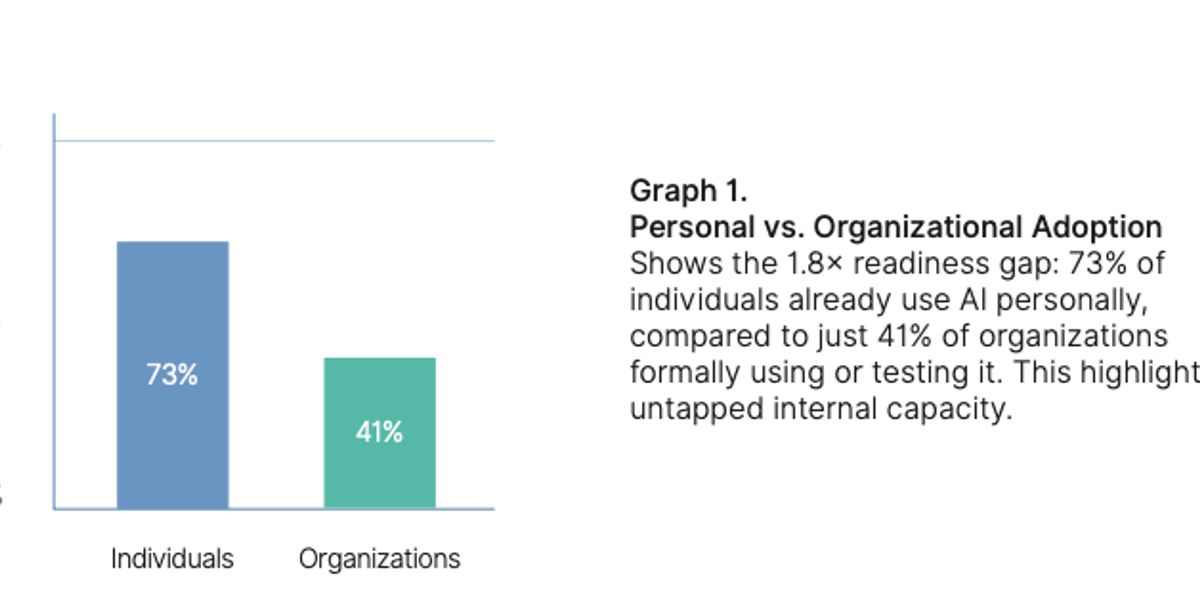
73% of professionals say they already use AI tools personally.
Yet only 41% of their organizations have officially adopted or even started testing AI systems.
That’s a significant 1.8× gap, and it tells a clear story: individuals are moving faster than their institutions. The workforce is ready. The systems and leadership models around them are still catching up.
This misalignment is the first major challenge for AI transformation in the region.
AI Is Already Working But Only in Select Areas
When asked where AI is already being used in their work, participants highlighted the following:
Content creation - 54%
Data analysis - 31%
Marketing and campaigns - 27%
Software development - 22%
Customer service or support - 14%
These early use cases are exactly where we would expect to see the most traction: high-volume, repetitive tasks where AI can increase speed or creativity without requiring deep integration into the actual legacy systems.
But this also reveals the next frontier: legal, finance, operations, logistics and strategic planning areas are still largely untouched and that is where future value lies.
Confidence Is High. But the Foundations Are Missing.
One of the most encouraging signs from the survey? Trust in AI is already here.
Over 70% of professionals say they mostly or completely trust the results they get from the AI tools they use. That means the technology is no longer a curiosity, but it's a tool people rely on.
But trust alone isn’t enough to move an entire organization.
When we asked what professionals actually need to feel ready for serious AI transformation, their answers painted a clear picture: it’s clearly the structure around them.
People want practical, local examples they can relate to.
They want training that fits into real schedules and not just theoretical courses. They want clear ownership inside their company: who’s driving AI, and what’s the plan for the future?
And above all, they want permission to experiment without waiting for a strategy document to land.
The problem isn’t technical. It’s structural, cultural, and organizational.
The Clock Is Ticking Fast
Perhaps the clearest consensus came when we asked a simple forward-looking question:
Do you believe AI will play a significant role in your work in the next two years?
88% said yes.
This wasn’t just among IT professionals or early adopters. Respondents from education, healthcare, law, agriculture, and government gave the same answer.
The shift is coming really fast. The only real question is who will be ready when it arrives.
What Happens Next?
In the coming weeks, we’ll explore key sections of the report in more depth.
But the big story is already visible.
AI transformation in North Macedonia is here and is already happening at the desks of curious, forward-thinking professionals.
What’s missing is alignment between people and process, trust and strategy, and what’s possible and what’s actually being supported.
That’s the challenge for 2025 and beyond. And we’re here to help navigate it.